
Declarations in Massachusetts Towns
The Declaration of Independence in Massachusetts
On May 9, 1776, about a month before Richard Henry Lee proposed a resolution on Independence in the Continental Congress, a committee in the Massachusetts House of Representatives brought in a resolve to instruct their members with regard to a proposed Declaration of Independence. The resolve asked every town in Massachusetts to debate the idea of Independence in Town Meeting, and then to instruct their representative to the Massachusetts Provincial Congress whether they would support independence with “their lives, their liberty and their fortunes.” The Commitee consisted of House Speaker James Warren, of Plymouth, Rep. William Story, of Ipswich, and Rep. Joseph Hawley of Northampton.
On May 10, 1776, the Massachusetts House vote to pass the resolve, and then sent it to the Provincial Council for concurrence. The Council (for unexplained reasons) “non-concurred.”
May 13, 1776 – the Committee which had brought forward the resolve ordered it to be published in the Boston Gazette.
The history of the Declaration of Independence from the perspective of the Continental Congress is well documented, beginning with the Lee Resolution on June 7, 1776, through the creation of the Committee of Five, through the adoption of Lee’s Resolution, the writing and editing of the Declaration and its subsequent publication as a broadside by John Dunlap and in various newspapers.
There are at least 3 copies of the Dunlap broadside in Massachusetts at the Massachusetts Historical Society, the Houghton Library at Harvard University and at Williams College in Williamstown, MA.
The first newspaper printing of the Declaration of Indepenence is in the Philadelphia Evening Post by printer Benjamin Towne. Copies of this newspaper can be found at the Boston Public Library and the American Antiquarian Society in Worcester.
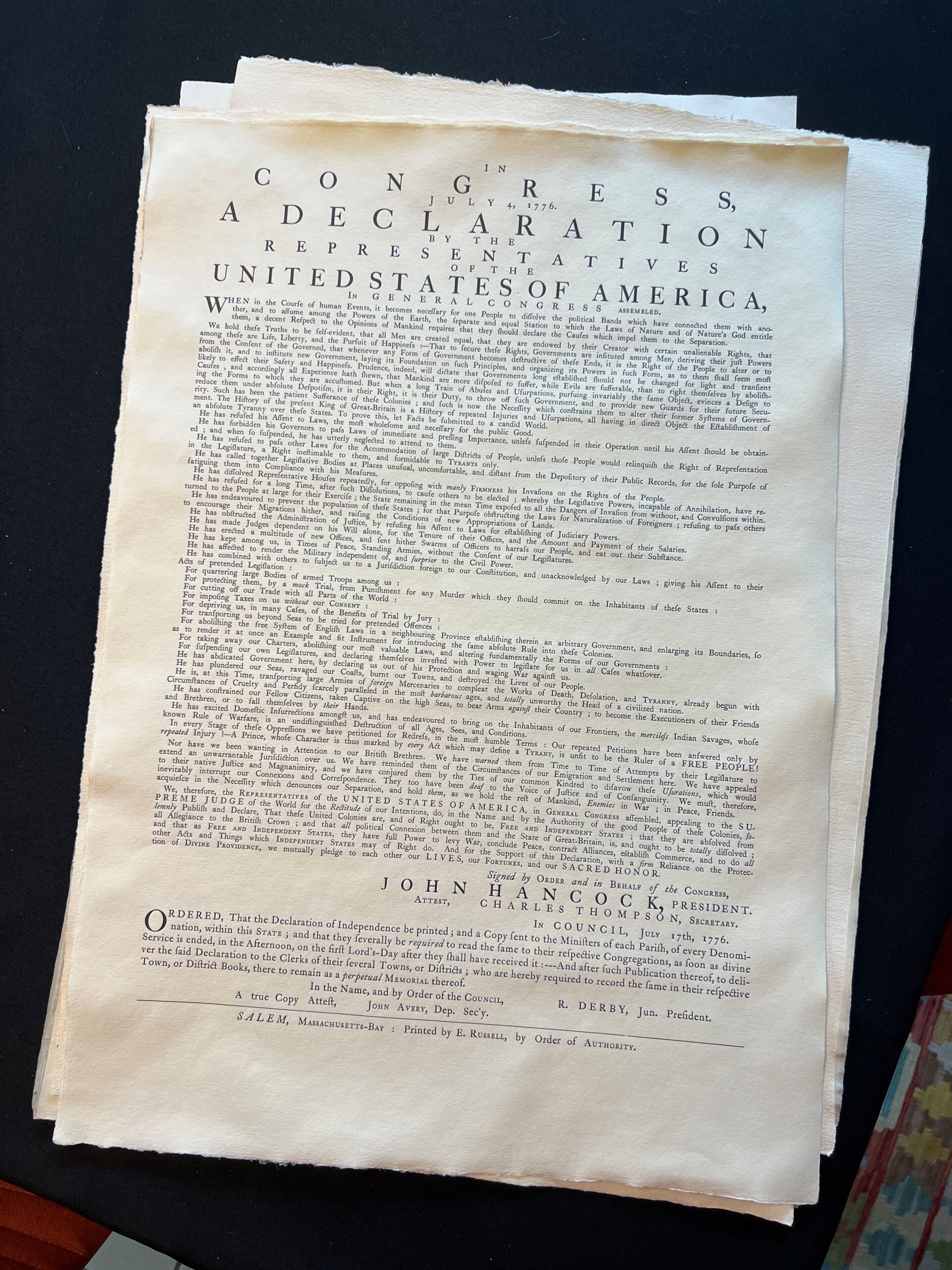
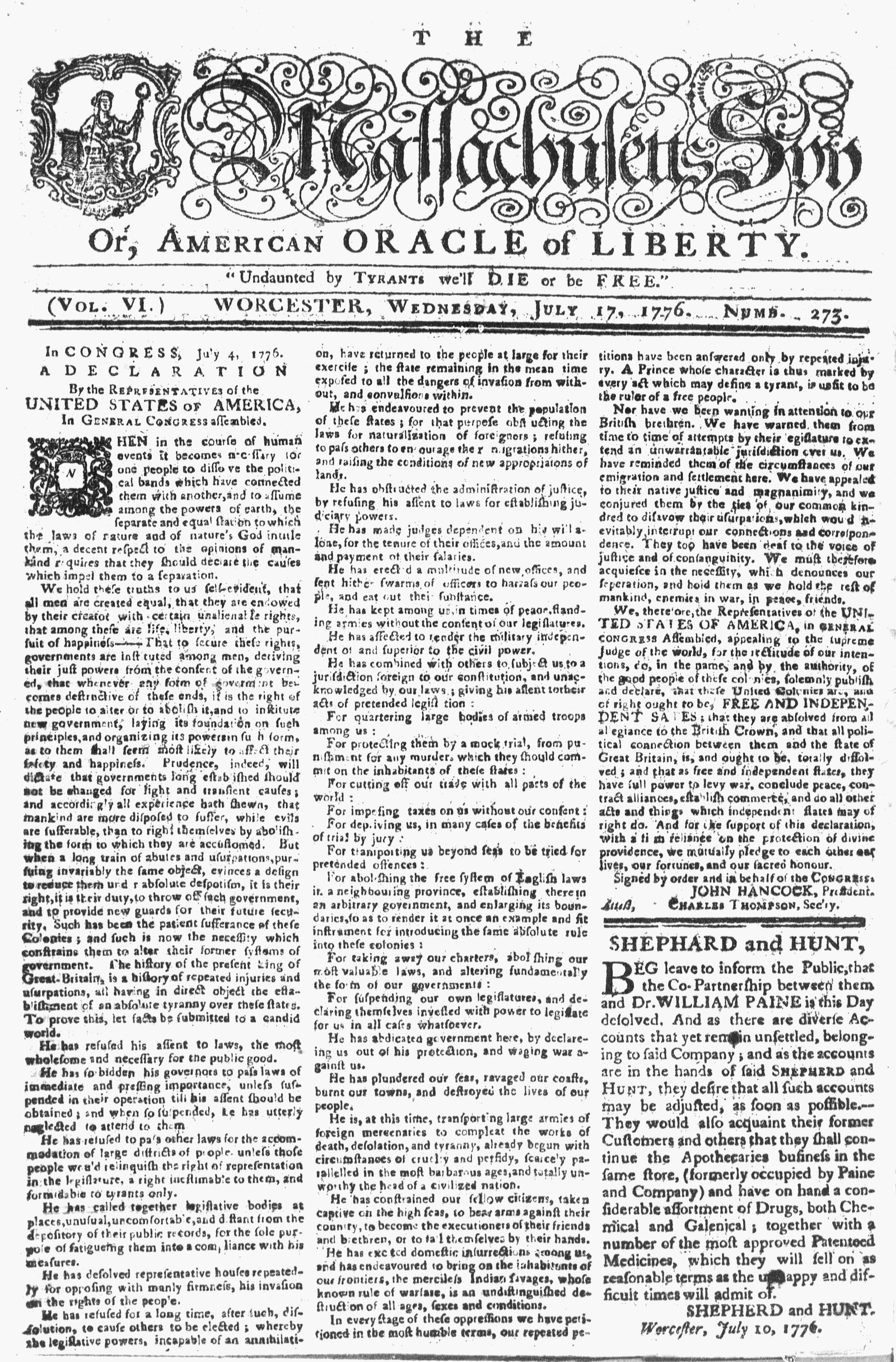 The Declaration of Independence arrived in Massachusetts sometime after the 13th of July, but before the 17th of July when the text was printed in broadside form by Ezekiel Russell in Salem and it was also printed in the Massachusetts Spy in Worcester. Tradition states that Isaiah Thomas, the “Patriot-Printer” read the broadside form the front steps of the First Parish Church on Worcester Common. The Provincial Congress considered how best to publicize the arrival of the Declaration and on the 17th of July, 1776 they reported to the House:
“Report of the Committee of Council appointed to consider in what manner the Declaration of Independence shall be declared:
“In Council, Ordered, That the Declaration of Independence be printed; and a Copy sent to the Ministers of each Parish, of every Denomination, within this State; and that they severally be required to read the same to their respective Congregations, as soon as divine Service is ended, in the Afternoon, on the first Lord’s-Day after they shall have received it: — And after such Publication thereof, to deliver the said Declaration to the Clerks of their several Towns or Districts; who are hereby require to record the same in their respective Town, or District Books, there to remain as a perpetual Memorial thereof. In the Name, and by Order of the Council, R. Derby, Jun. President; A true Copy attest, John Avery, Dep. Sec’y.”
Then The committee reported: Your Committee appointed to consider in what manner the Declaration of Independence made by the Honble Continental Congress should be proclaimed & published to the good people of this State, beg leave to report as their opinion;
That the said Declaration be proclaimed by the Sheriff of the County of Suffolk from the Balcony of the State House in Boston on Thursday next at one o’clock p.m. in presence of and under […?…] of a Committee of Council to be appointed for that purpose – that the Representatives, the Magistrates, Selectmen and Ministers of the said Town, the commissioned officers of the Continental Army and of the Militia of Boston stationed in Boston & also of the colonial regiments there be desired to meet at the Council Chamber at that time and that the militia of the Town of Boston & such of the Continental Army & of the Colonial Regiments as can be spared from duty be drawn up in State Street at the same time.
That the Said Declaration be also proclaimed at the Meeting House in Watertown at the same time in a similar manner as nearly as the difference of circumstances permit.
So, On July 18, 1776, Sheriff of Suffolk County, William Greenleaf, read the Declaration of Independence from the balcony of the State House (now the “Old” State House) in Boston. Because his voice was weak for the purpose, Greenleaf asked his friend Thomas Crafts, a commander of Artillery in Massachusetts known for his booming voice, to repeat each sentence of the Declaration as the Sheriff spoke them. Thus together, they proclaimed the Declaration of Independence.
On the same day in Watertown, it was the Secretary of the Council, Perez Morton who proclaimed Independence from the second floor of the Edmund Fowle House. Morton is perhaps most notable for his eloquent eulogy on the life of his friend and political ally, Dr. Joseph Warren, killed at the Battle of Bunker Hill. Morton’s eulogy was delivered during the reinterrment of Warren’s body in King’s Chapel in April, 1776.
“And after such Publication thereof, to deliver the said Declaration to the Clerks of their several Towns or Districts; who are hereby require to record the same in their respective Town, or District Books, there to remain as a perpetual Memorial thereof.”
The 18th of July, 1776 was a Thursday. It is likely the ministers had these broadsides in time for Sunday, the 21st of July. So, in the afternoon of July 21, 1776 the people of Massachusetts, finishing with their afternoon services, sat and listened to their local minister read out the Declaration of Independence. Following that moment, the minister was instructed to pass the broadside on to the Town Clerk as ordered above.
We’re collecting images of those hand written Declarations and you can see if we have your town’s copy below.
Massachusetts Towns A – D
Massachusetts Towns E – I
Massachusetts Towns J – M
Massachusetts Towns N – R
Massachusetts Towns S – Z